

Plateau des Mille Vaches
Mille Vaches Plateau
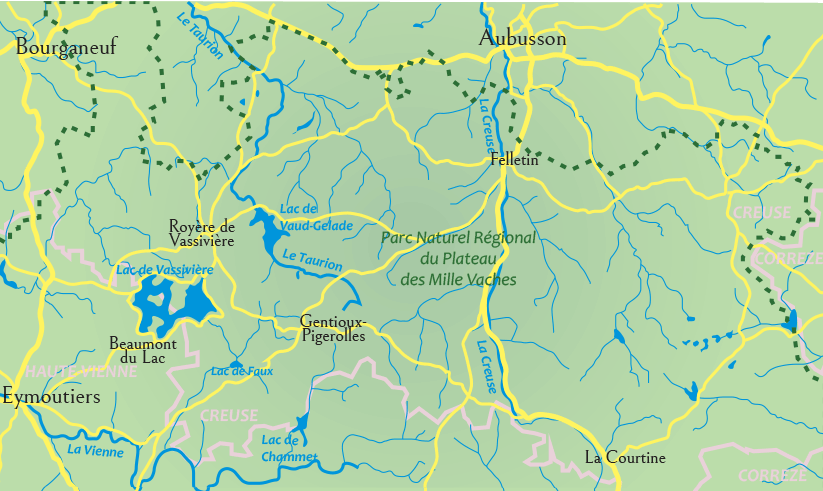
Le Plateau des Mille Vaches est à cheval sur trois départements : la Corrèze, la Creuse et la Haute-Vienne.
Il est certain que son
nom n'est pas lié aux vaches ou bovins. L'explication la plus répandue est qu'il voudrait dire des Mille Sources, ce qui correspond à l'abondance de sources issues
du plateau. Une autre explication serait "haut et vide", moins évident si l'on considère la topographie, proche du Massif Central et l'occupation humaine, peu
abondante mais pas vide.
The Mille Vaches Plateau straddles three departments: Corrèze, Creuse and Haute-Vienne.
It is certain that its name
is not related to cows or cattle. The most widespread explanation is that it would mean "a thousand sources", which corresponds to the abundance of
sources from the plateau. Another explanation would be "high and empty", less obvious if we consider the topography, close to the Massif Central and
the human occupation, not very abundant but not empty.
Présentation et informartions
L'activité principale du plateau des Mille Vaches est l'exploitation forestière. Beaucoup de population extérieures se sont installées pour la beauté des lieux,
le choix d'une vie alternative et plus proche de la nature. Les confrontations entre les exploitants et habitants d'origine avec les "nouveaux arrivants"
sont régulières.
Historiquement, l'occupation néolothique ne montre pas d'occupation permanente du site, probablement en raison du climat froid. C'est sous la période gauloise,
que l'occupation se sédentarise avec l'amélioration de l'outillage agricole. De nombreux tumulus attestent cette occupation.
La période romaine a laissé des vestiges également, la sédentarisation se confirme donc à partir les Gaulois.
Comme le Parc Naturel Régionale des Mille Vaches et beaucoup d'autres organisation proposent des
informations très complètes sur le Plateau, nous nous contenterons ici de présenter
des lieux liés à Aubusson et Bourganeuf situés dans le plateau et des lieux insolites à découvrir.
Presentation and informations
*
The main activity of the Mille Vaches plateau is forestry. Many outsiders have settled for the beauty of the place, the choice of an alternative life
closer to nature. Confrontations between operators and original inhabitants with "newcomers" are regular.
Historically, the Neolithic occupation does not show a permanent occupation of the site, probably due to the cold climate. It is under the Gaulish period
that the occupation becomes sedentary with the improvement of agricultural tools. Many tumuli attest to this occupation.
The Roman period also left remains, so sedentarization has been confirmed since the Gauls.
As the Mille Vaches Natural Regional Park and many other organizations offer
very complete information on the Plateau, we will only present here some insolite places.