

Guéret
Guéret
Ancienne capitale du comté de La Marche, Guéret est le chef-lieu du département de la Creuse. Elle concentre ainsi les administrations
du département. Elle est relativement centrale.
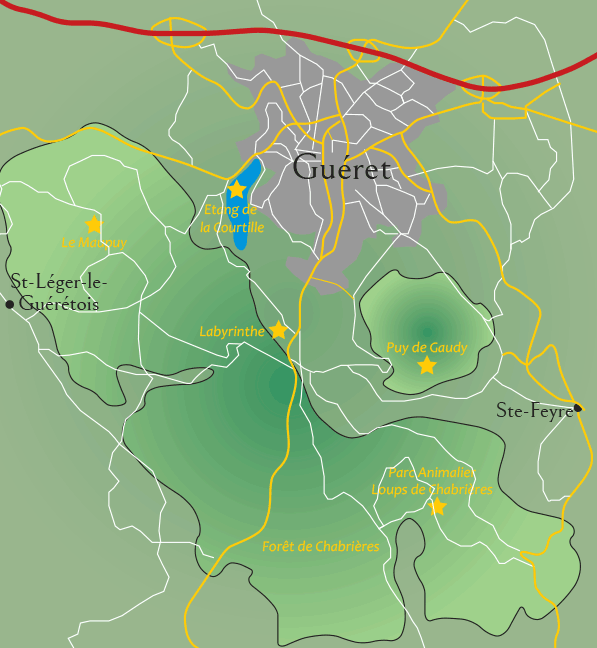
Située au pied des monts du
Puy de Gaudy et du Maupuy et leurs zones forestières et au départ du bocage marchois,
zone plate agricole au nord, Guéret accueille le
Musée d'Art et d'Archéologie.
L'étang de Courtille fait partie de la ville et accueille une base de loisirs nautiques et jeux pour enfants. Aux alentours,
les Loups de Chabrières peuvent être rencontrés en milieu naturel.
Dans les monts alentour, de belles randos nature et histoire vous attendent.
Former capital of the county of La Marche, Guéret is the chief town of the department of Creuse.
It thus concentrates the administration of the department. It is relatively central.
Located at the foot of the mountains of Puy de Gaudy and
Maupuy and their forest areas and at the start of the Marchois grove, flat agricultural area to the north, Guéret hosts the museum of Art and Archeology.
The pond of Courtille is part of the city and hosts a water sports base and games for children. In the surroundings, the
Wolves of Chabrières can be encountered
in a natural environment. In the surrounding mountains, beautiful nature and history hikes await you.
Un peu d'histoire
L'occupation gauloise et gallo-romaine se situe sur le Puy de Gaudy, l'occupation humaine du bas cultivale intervient au début du Moyen-Âge.
La ville prend naissance avec l'installation sur le domaine de Waractus (le W germanique se traduit en G en langues romanes), ou Garet, au VIIe siècle avec
la création d'un monastère. La ville est rasée par les Vikings au IXe siècle, s'en suit la reconstruction d'une bourgade. Elle devient capitale du compté de
La Marche en 1514.
Comme beaucoup de Creusois, les hommes de Guéret font partis des maçons envoyés dans les grandes villes pour les grands
chantiers du XIXe siècle.La ville suit les aléas de l'histoire de France, révolte de 1848, guerres du XXe siècle et maquisat dans les monts alentours.
Aujourd'hui, Guéret compte moins de 13 000 habitants et son agglomération environ 28 500.
A bit of history
The Gaulish and Gallo-Roman occupation is located on the Puy de Gaudy, the human occupation of the lower
Cultivale occurs at the beginning of the Middle Ages. The city begins with the installation on the estate of Waractus
(the Germanic W is translated into G in the Romance languages), or Garet, in the 7th century with the creation of a monastery.
The city was razed by the Vikings in the 9th century, followed by the reconstruction of a small town. It became the capital of La Marche county in 1514.
Like many Creusois, the men of Guéret are part of the masons sent to the big cities for the major projects of the 19th century.
The city follows the vagaries of the history of France, revolt of 1848, wars of the 20th century and maquisat in the surrounding mountains.
Today, Guéret has less than 13,000 inhabitants and its agglomeration about 28,500.